

Most health systems do not have an AI problem. They have an instrumentation problem. Walk into almost any revenue cycle department today and you will find AI pilots running somewhere, a denial-prediction model here, an ambient documentation tool there. What you will rarely find is a connected system that lets those pilots add up to something bigger than themselves. The tools work. The infrastructure underneath them does not. That gap is expensive. Revenue cycle management already consumes 3 to 4% of total revenue at a typical health system, more than $140 billion a year industry-wide, the large majority of it labor cost. Teams are understaffed and attrition in revenue cycle operations centers has run above 30%, and payers keep adding requirements faster than short-staffed teams can absorb them. Up to 60% of denials are never even appealed, simply because no one has the hours to chase money the organization has already earned. Hiring more people will not close that gap. Neither will another point-solution tool on its own. What works is instrumentation, the connective tissue of clean data, defined workflows, clear ownership, and honest metrics that let AI operate at scale instead of stalling as a permanent pilot. Here is what that looks like in practice, and where to start.
Why AI Pilots Stall Before They Scale
The pattern shows almost the same way at every organization. A team stands up a promising point solution, often around denials or documentation, sees encouraging early results, and then hits a wall trying to expand it. The reasons are rarely about the AI itself. They are structural, and they tend to repeat across organizations.
- Fragmented data
Claims, clinical documentation, and payer correspondence often live in systems that do not talk to each other, so any AI model is only ever seeing part of the picture.
- No shared ownership
IT owns the tool, revenue cycle owns the outcome, and nobody owns the handoff between them.
- Success metrics that do not match reality
Judging AI purely on short-term write-off reduction misses its effect on staff workload, patient experience, and downstream cash flow, so leadership cannot tell if the investment is working.
- Ad hoc funding
One-off pilot budgets do not account for the trial-and-error period every new automation layer needs before it is reliable. None of these are AI failures. They are readiness failures. And they are exactly what instrumentation is designed to fix before automation gets asked to do more.
What Instrumenting the Revenue Cycle Means
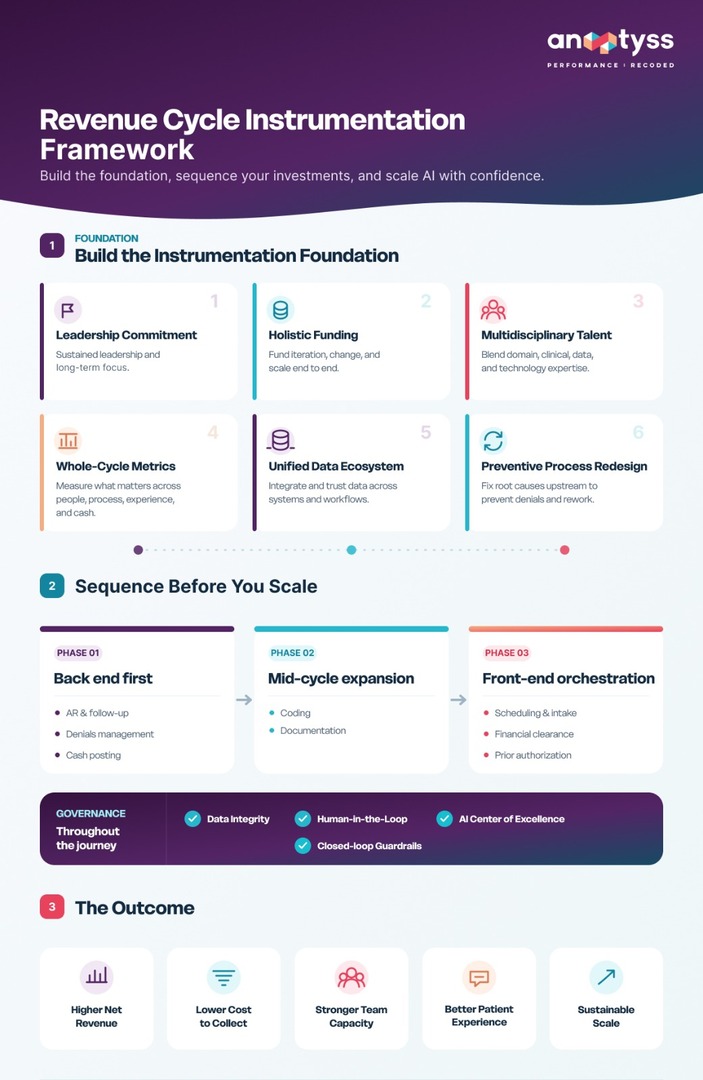
Instrumentation is the shift from isolated AI experiments to a coordinated operating layer, a central nervous system that connects clinical reality to financial outcomes across the whole revenue cycle, not just one department’s corner of it. In practice, it rests on six pillars.
- Leadership Commitment for the Long Haul
Instrumentation is not a one-quarter initiative. It requires leaders willing to fund iteration and adjust course as new capabilities mature, rather than expecting a single tool purchase to fix the cycle.
- Holistic Funding
Budgets need to account for the transition period, the downtime, retraining, and trial-and-error every new workflow layer requires, instead of treating each AI tool as a standalone line item.
- Multi-Disciplinary Talent
Closing the skills gap means teams that combine revenue cycle domain knowledge, technical implementation skill, and clinical fluency.
- Metrics that Reflect the Whole Picture
Write-off reduction alone is a misleading scoreboard. Real success indicators include staff time recovered, documentation accuracy, patient billing experience, and cash flow stability together.
- A Unified Data Ecosystem
Messy, siloed data is the single biggest barrier to scaling AI past a pilot. Instrumentation means structuring systems for interoperability and cutting redundant, overlapping tools before adding new ones.
- Process Redesign Aimed at Prevention
The end goal is not a faster way to manage denials. It is real-time documentation reconciliation and upstream workflow alignment that prevent many denials from happening at all. Get these six pillars in place, and AI stops being a collection of disconnected experiments and starts operating as infrastructure.
A Phased Roadmap for Instrumenting the Revenue Cycle
Trying to instrument the entire revenue cycle at once is how most transformation budgets get burned. The organizations seeing real results are sequencing it instead, starting where risk is lowest and patterns are clearest, then expanding outward.
Phase 1: Back-End First
Accounts receivable follow-up, denials management, and cash posting are rules-governed, high-volume, and low clinical risk, which makes them the ideal proving ground. The patterns here are consistent enough for AI to learn quickly, and the upside is directly measurable in recovered cash and reduced rework.
Phase 2: Mid-Cycle Expansion
Once the back end is instrumented, the natural next step is clinical documentation improvement and coding, areas where AI’s advantage is processing at scale. A single complex inpatient record can contain up to 30,000 discrete data points. Consistently and accurately capturing that level of clinical context is well past what manual review can sustain at volume.
Phase 3: Front-End and Full-Cycle Orchestration
The end state connects every workflow, including scheduling, intake, financial clearance, and prior authorization, into one orchestration layer. This is also where the highest-friction, most patient-facing problems live, which is exactly why it should not be phase one. Prior authorization is where front-end friction concentrates, with 71% of provider executives ranking it a top-three bottleneck to revenue realization, and AI-enabled prior authorization prevents downstream denials before a patient ever reaches the billing office.
What to Automate First While You Build the Rest of the Foundation
Across recent industry surveys, often labeled “no-regret moves,” no single dominant use case has emerged, but a consistent short list has formed of initiatives that deliver value fast enough to justify investment even while the rest of the instrumentation work is still underway.
- Ambient documentation integrated directly with revenue cycle workflows
- Clinical documentation integrity (CDI), using NLP to catch gaps at the point of capture
- Scaling prior authorization and electronic prior authorization (ePA)
- Coding automation
- Real-time performance dashboards for cycle-wide visibility
- Denial prevention and prediction, not just denial management after the fact
The projected gains are substantial. McKinsey estimates that an AI-enabled revenue cycle could cut cost to collect by 30 to 60%. R1 RCM puts the potential net revenue gain from full-cycle orchestration at 5 to 7% and reports throughput improvements near 60% in its own early deployments. Independent studies have found clinical documentation accuracy reaching 90% or higher in narrow clinical domains. Those numbers are not the result of any single tool. They are what happens when the six instrumentation pillars are in place underneath the tools.
Why Governance Is What Makes AI Safe to Scale in the Revenue Cycle
The organizations that scale AI successfully treat it as a coworker, not a replacement. That means keeping humans in the loop by design. Agents handle the high-volume, pattern-based work, while people manage complex exceptions, edge cases, and compliance judgment calls that should not be fully automated in a regulated environment. Three governance elements tend to separate the organizations that scale from the ones that stall.
- Data integrity standards that catch bias and inconsistency before they compound across thousands of automated decisions.
- A dedicated AI center of excellence, a structure some providers are now standing up, bringing together product owners, development leads, data scientists, and operations leaders to govern how new capability gets introduced.
- Closed-loop guardrails, where computer-generated outputs get human validation rather than flowing straight through unchecked, a difference that matters enormously in reimbursement, where a single systematic error can replicate itself across thousands of claims before anyone notices.
How This Changes the Role of Your Revenue Cycle Staff
The instrumentation shift does not shrink the revenue cycle workforce. It changes what that workforce spends its time on. Staff move away from repetitive, high-volume manual tasks and toward training and supervising AI agents, resolving the complex exceptions that need human judgment, and interpreting the higher-level patterns instrumentation makes visible for the first time. In a labor market this tight, that is not a cost center. It is the most sustainable way to get capacity back. Ready to instrument your revenue cycle before you scale AI?
Talk to our team about building the data foundation, governance, and phased roadmap that turn AI pilots into durable infrastructure.
Leave a message