Documents Arrive From
Everywhere
Borrower email, broker portal, branch scan and e-sign platform each name and format the same document differently.
Risk & Compliance
Financial Operations
Customer Experience
AI Engineering & Services
Banking & Financial Services
Crypto & Digital Assets
Hi-Tech
Retail & Consumer
Energy & Utilities

Document classification and indexing that reads, routes and files high-volume documents, 50 to 70% faster and at up to 50% lower indexing cost.
Request a DemoIndex AI turns manual, process-dependent indexing into structured, automated workflows. It identifies and classifies documents across six operational queues without human intervention, removing the manual effort that slows processing and introduces error.
Document handling looks like a filing problem. It is a retrieval problem, and it only becomes visible when someone needs the file and it is not where it should be.
Borrower email, broker portal, branch scan and e-sign platform each name and format the same document differently.
A document called financials.pdf could be a tax return, a rent roll or a bank statement. Someone has to open it to know.
A document in the wrong queue is not a problem until an investor, an auditor or a customer asks for it.
Manual stare and compare work is fatigue work. The last hour of indexing is not the same as the first.
A rate move, a portfolio purchase or a campaign multiplies intake in a week. Hiring and training an indexer takes longer.
A short file is discovered when the trailing document report runs, not when the document failed to arrive.
Faster document processing.
Lower manual indexing cost.
Documents classified and routed across six operational queues without re-keying.
The classification engine learns from corrections, so accuracy improves on your own document mix.
Automatically classifies incoming documents for structured processing.
Enables the transformation of physical records into structured digital assets using a standardized digitization framework.
Handles growing document volumes without increasing workforce requirements.
Sustains well-structured records repositories designed for compliance, control, and audit traceability.
Classification is based on structure, content patterns and contextual signals inside the document, so a mislabelled or unlabelled file still lands in the right queue.
Every reclassification feeds the engine, so accuracy improves on your own document mix rather than on a generic training set.
Six operational queues across closing, post-closing and servicing, configured to how lending files actually move rather than to a generic document taxonomy.
Low-confidence classifications and exceptions route to trained operations staff who work them to your standards, inside your systems.
Index AI is built on advanced document understanding models and enterprise automation architecture that transform unstructured content into structured, workflow-ready information.
Analyzes structure, content patterns, and contextual signals to accurately identify document types.
Fields read in the context of the document, so a date of birth is not confused with a closing date.
Each document sent to the right queue and owner with the data already attached.
Classification improves from reviewer corrections over time.
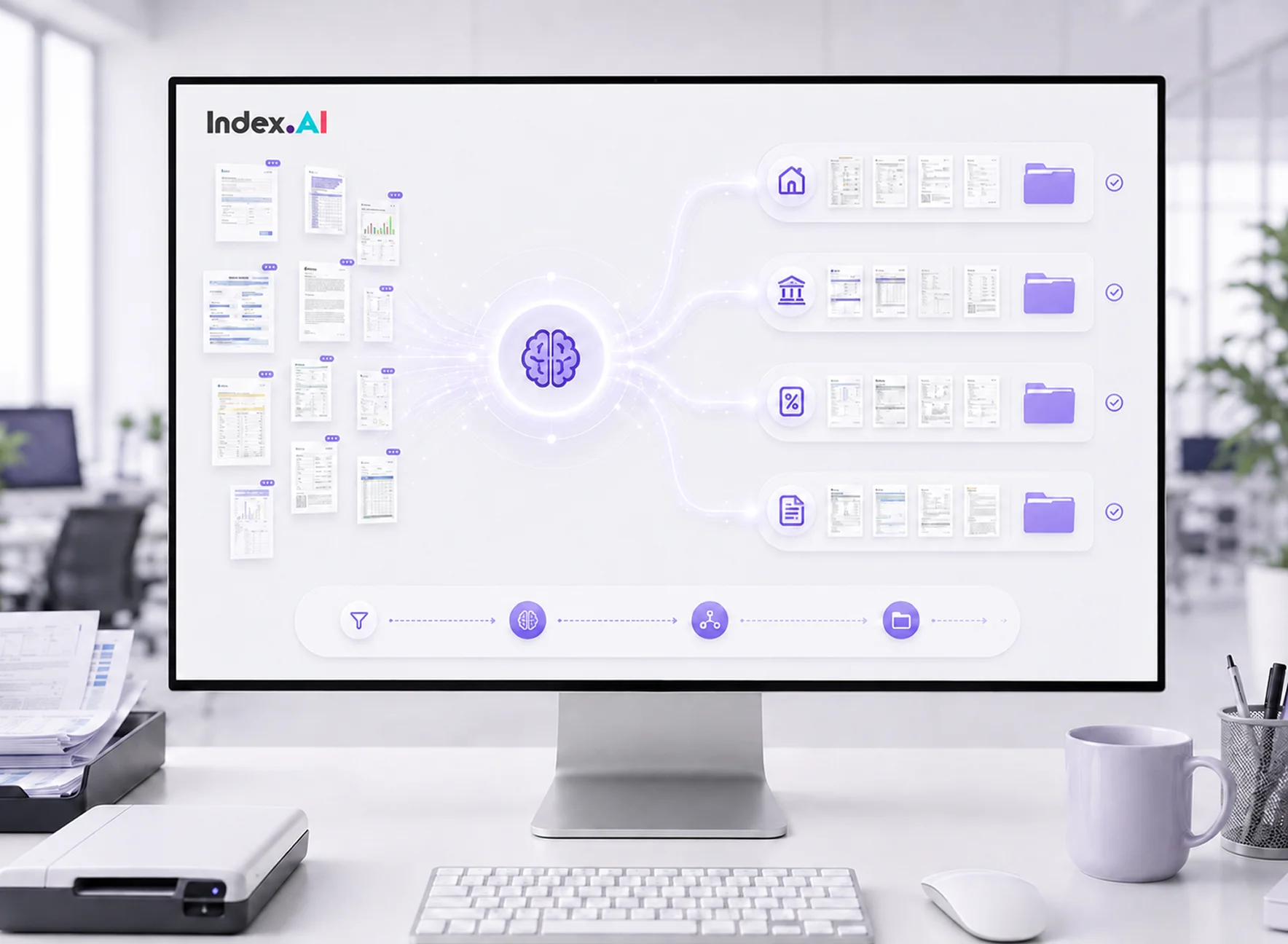
Index AI manages the document lifecycle from closing through servicing and lifecycle reviews, with accurate classification, real-time tracking and fast retrieval.
Documents arrive from any channel, including scanned images, email attachments and portal uploads.
The engine identifies the document type from structure, content patterns and contextual signals.
Key data is read from the document and mapped to the loan, borrower or account record.
Each document is directed to the correct operational queue with the right owner and priority.
Low-confidence classifications route to a trained operator rather than being written straight through.
Documents are indexed into the repository with a traceable record of how each one was classified.
Reduce cost per document by eliminating manual sorting and indexing.
Ensure consistent routing across operational workflows.
Shift teams from repetitive processing to exception handling and decision-making.
Accelerate post-closing and servicing timelines with automated document flow.
Process demand spikes without increasing staffing.
Minimize risk caused by manual fatigue and inconsistent classification.
Enable structured access and review of CLM documentation.
Maintain organized, traceable records for audit and regulatory requirements.
Improve retrieval speed for servicing operations and customer requests.
See Index AI classify and extract from your own document set.